New Zealand signs use familiar international ideas but local road situations can surprise visitors. One-lane bridge priority, advisory corner speeds and temporary controls need recognition before the road narrows.
Limits and advisory numbers
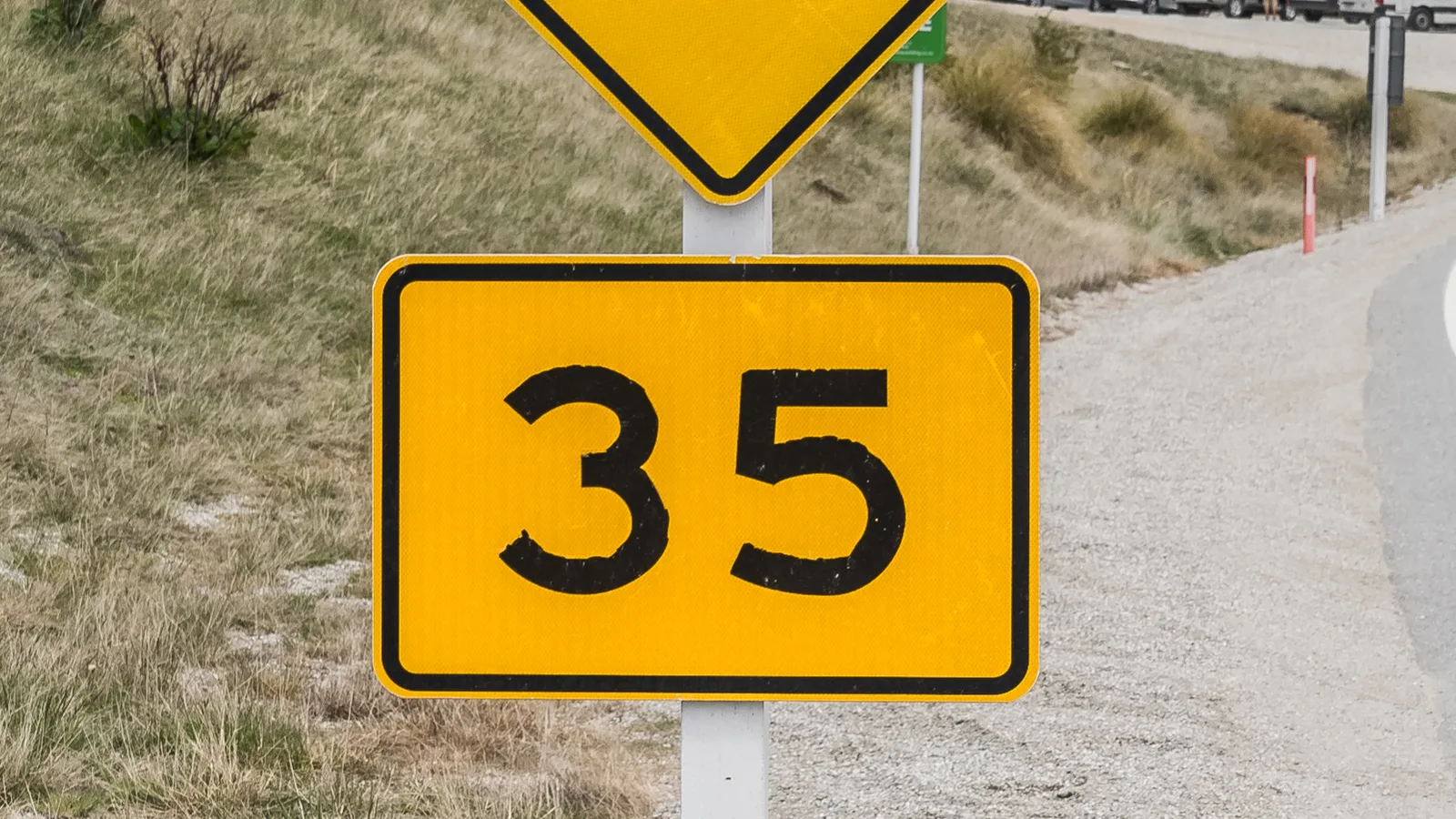
A red-ring speed sign sets the maximum legal speed; a yellow advisory number indicates a safer corner speed rather than a new limit. Conditions can require travelling below both.
Temporary orange signs and portable limits are enforceable where installed. Continue obeying them until the end of the work zone.
One-lane bridges
A red-bordered give-way sign means traffic from your direction must yield. A blue rectangular priority sign gives your direction priority, but only when the bridge is clear and safe to enter.
Check for long or heavy vehicles already committed and never race another driver to the entrance.
Rail and rural hazards
Stop or give way at railway controls as signed, look both ways and never queue across tracks. Rural warning signs also identify stock, slips, ice and winding roads.
Learn the official visitor-driving material before collecting a rental. Navigation prompts do not explain the meaning of a roadside instruction.
Give Way rules at intersections
New Zealand's give way rules changed in 2012 and older overseas guidance is wrong. The current position is that at an uncontrolled intersection or when both vehicles face the same control, a turning vehicle gives way to a vehicle going straight through or turning left.
Roundabouts run clockwise and you give way to traffic on your right. Signal left as you leave, and take particular care on multi-lane roundabouts where lane markings determine which exit you may take.
- Turning gives way to straight-through
- Roundabouts run clockwise
- Give way to your right
One-lane bridge signage
One-lane bridges are common, particularly on the West Coast and in Northland. The sign shows two arrows: the larger black arrow indicates the direction with priority. If your arrow is the smaller red one, you give way to oncoming traffic.
Some bridges are shared with rail, and a few are long enough to include passing bays. Slow on approach, look right through the bridge before entering, and be willing to wait rather than racing to claim it.
Advisory speeds and hazard warnings
Yellow diamond signs are warnings rather than legal limits, and the yellow speed shown on a corner is an advisory maximum for a car in good conditions. In a loaded campervan, in rain, or towing, the safe speed is lower than the advisory figure.
Watch for the signs specific to New Zealand conditions: slippery when wet, loose metal, ford, stock crossing and the falling rocks warning used widely on the West Coast and through the passes.
- Yellow signs are advisory, not legal
- Advisory speeds assume a car in the dry
- Loose metal means gravel
Passing lanes and slow vehicle bays
Passing lanes are infrequent on New Zealand highways, and the courteous and expected behaviour if you are slower than the traffic behind is to use the slow vehicle bay or pull over where safe and let them pass. This is more than politeness; frustrated following drivers cause overtaking crashes.
Do not accelerate in a passing lane when someone is overtaking you. If five or more vehicles are queued behind you, you are legally required to pull over as soon as it is safe to do so.
Signs specific to New Zealand
LSZ marks a Limited Speed Zone on some rural roads, where the limit drops when conditions require it. A Ford sign means the road crosses a watercourse, which may be dry or impassable depending on recent rain.
Stock crossing and stock effluent signs indicate active farming use of the road. Slippery when wet appears widely on sealed rural roads where the chip seal becomes genuinely slick, and it is worth taking seriously in a heavy vehicle.
Blue and white signs mark tourist routes and services while brown signs indicate historic and cultural sites. Neither implies the road beyond is suitable for a large vehicle, so check that separately before turning off.
Roadworks and stop-go
Temporary works are frequent, particularly after winter damage, and a stop-go operator directing traffic has legal authority. Wait for the signal rather than following the vehicle in front through a closing gap.
Temporary limits apply whether or not work is visibly happening, including overnight and at weekends. The surface through works is often loose chip, which is genuinely slippery for a heavy vehicle.
- Stop-go operators have legal authority
- Temporary limits apply at all hours
- Loose chip is slippery
Orte entlang der Strecke
Vor der Abfahrt prüfen
Regeln und Bedingungen ändern sich. Prüfe vor der Abfahrt noch einmal die offizielle Quelle und die Seite deines konkreten Parks oder Campingplatzes.
Häufige Fragen
Are New Zealand road signs different from other countries?+
The shapes and colours will feel familiar, but the ones that catch visitors out are local: one-lane bridge priority arrows, the LSZ limited speed zone, and the yellow warning signs for gravel changes and stock crossings.
What does the one-lane bridge sign mean?+
The large arrow is your direction and the small arrow is the oncoming one. If your arrow is the small one, you give way, and on a long bridge that means waiting at the entrance rather than committing and reversing.
Nimm es mit auf die Straße
Stopps speichern. Ganze Reise planen.
Bau aus gespeicherten Orten eine geordnete Route, berechne die Entfernung und behalte Termine, Notizen und To-dos daran.