Buying a campervan in New Zealand means a current WoF and licence (rego), a change of ownership recorded with NZTA, a PPSR check for money owing and, if you want to freedom camp on public land, a green self-containment warrant. The rules for the warrant of fitness change on 1 November 2026, and blue self-containment stickers stopped counting on 7 June 2026. NZTA's own site blocks automated readers, so the NZTA figures below are the points its pages state in plain text, and you should confirm fees and forms on the live NZTA pages before you pay.
Dealer or private sale
Consumer Protection explains the main difference. A dealer must be on the Motor Vehicle Traders Register, is bound by the Consumer Guarantees Act and the Fair Trading Act, and must attach a Consumer Information Notice with the vehicle's history, price, odometer reading and money owing. "As is where is" does not remove your rights with a dealer.
A private seller need not be registered, show that notice or follow those Acts, so you have far fewer rights, though a private seller still must not mislead you and you can claim through the Disputes Tribunal. Travellers Autobarn, a licensed dealer in Auckland and Christchurch, sells ex-rental Toyota Hiace campervans, offers a 3-day money-back guarantee for a serious mechanical issue and a 10,000 km or 6 month engine and gearbox warranty on ex-rental vans with a $4,200 claim limit, and lets you try a van for up to 7 days with rental charges deducted if you buy. Its NZ page shows no prices, so ask for the current price list.
- Dealers carry legal duties
- Private sales carry few rights
- Get any warranty in writing
Check money owing with the PPSR
A van with money owing on it can be taken back by the lender even if the seller never mentioned it. Consumer Protection tells buyers to search the Personal Property Securities Register by registration number, chassis number or VIN, with the VIN best. A search costs $2.30 with GST, results are kept for 14 days and you confirm a legitimate reason for searching.
The same checklist suggests checking whether the vehicle has been written off or water damaged, whether it is reported stolen, whether the odometer is consistent and getting an independent inspection. If you buy from a trader that did not disclose a registered security interest you take the vehicle free of it, but that protection does not apply to a private sale.
- Search by VIN
- Pay an independent mechanic to look
- Do the PPSR check before you pay
Turn the stops into a trip
WoF, rego and the 1 November 2026 change
Light vehicles registered on or after 1 January 2000 need an annual WoF now. NZTA does not set the inspection price, so garages do, and NZTA charges $4.16 for the label. From 1 November 2026, light vehicles registered on or after 1 November 2019 move to a WoF every 2 years, those registered between 1 November 2013 and 31 October 2019 move on 1 November 2027, vehicles 14 to 26 years old stay annual, and vehicles registered before 1 January 2000 move from 6-monthly to annual. The infringement fee for a WoF expired by more than 2 months rises from $200 to $350. A typical backpacker campervan, such as a 2000s Hiace, falls in the 14 to 26 year band and stays annual.
Registration, called rego, is a separate licence with an ACC levy and an admin fee, and the price depends on the vehicle and the period. NZTA's licensing fees page lists the fee tables, so read it for your vehicle on the day you buy. The WoF and rego guide explains what to look for on the labels.
- Aim for a long WoF and rego
- Annual WoF applies to most older vans
- Read the NZTA fee table on the day
Change of ownership
NZTA says a buyer must tell it immediately and that the change online is free, and a seller should do it straight away at the time of sale. The paperwork is form MR13B. NZTA's page gives no deadline in days, and delay can leave the previous owner liable for licence fees. For an individual, the seller can only check a New Zealand driver licence as ID, and NZTA says a buyer without a New Zealand driver licence must go to an NZTA agent. With no valid ID the owner is recorded as incomplete.
This guide did not find an NZTA page that sets out what an overseas visitor needs to prove an address, so ask the agent before you hand over the money. Bringing your own vehicle to New Zealand is a different process (a temporary import, form MR2C) and is outside this guide.
- Do it online with the seller
- Overseas licence holders use an agent
- Keep proof of the change
Road user charges for diesel
Diesel vans pay road user charges, bought in advance in units of 1,000 km. NZTA's factsheet and its April 2024 rate schedule give $76.00 per 1,000 km including GST for a light diesel vehicle of 2 axles up to 3,500 kg, but NZTA changed some RUC types from 6 August 2026 and its live rates page could not be read, so confirm the current rate. The licence belongs to the vehicle, so unused RUC passes to the next owner, and you can claim a refund on a vehicle you sell, scrap or export if the unused amount is at least $20 within 2 years of the licence issue date.
The odometer matters: check the RUC label against the odometer reading when you buy, so you do not inherit someone else's overrun.
- Check the RUC label against the odometer
- Confirm the current rate with NZTA
- Petrol vans do not pay RUC
The green warrant for freedom camping
A blue self-containment sticker stopped counting for freedom camping on 7 June 2026. Only a green warrant does now: the certificate plus a green warrant card displayed in the vehicle, with the details in the national register so officers can check on the spot. It lasts 4 years and comes from a certification authority regulated by the Plumbers, Gasfitters and Drainlayers Board.
The vehicle needs a toilet permanently fixed to it and usable inside, since portable toilets no longer qualify, plus water supply, wastewater, ventilation, sink and rubbish storage systems. The cost is the certifier's own inspection fee, which is not published centrally, plus a $120 levy including GST. Size alone does not decide eligibility. The warrant lets you freedom camp on public land where self-contained vehicles are permitted, and it does not apply in campgrounds, holiday parks or on private property. The warrant guide has the full requirements.
A van advertised as self-contained should have the green card and a current entry in the register, so ask to see both.
- Green warrant only
- Fixed toilet needed
- Ask to see the warrant and the register entry
What vans cost to buy
This guide could not read Trade Me, which shows no listing text to automated readers, or Backpacker Board, which blocks them, so it quotes no asking-price range for typical backpacker vans. The one dated figures read directly are Turners auction starting bids closing on 26 October 2026: a 1995 Toyota Dyna motorhome at $10,699 with 110,628 km, a 1990 Mazda T3500 motorhome at $15,500 with 96,466 km and a 2011 Volkswagen Crafter 50 motorhome at $63,000 with 283,643 km. These are heavier, older motorhomes rather than typical Hiace backpacker vans.
Search the same make and year on Trade Me and Backpacker Board on the day you buy, compare at least five listings, and treat asking prices as the start of a negotiation, not a sale price. Travellers Autobarn's NZ page quotes buy-back figures that do not agree with each other (50% in the text, 40% in an example), so get any buy-back schedule in writing.
- Compare at least five listings
- Asking price is not sale price
- Buy-back terms in writing
Check the van and the route in KiwiCamping
KiwiCamping lists 287 DOC campsites and 927 DOC huts in its bundled data (as of 24 August 2026). Once you own a van, you can search by place, filter by facilities and cost, save the places you want and build a trip with ordered stops, distances and drive times. Saved places and their details still open in a dead zone; only the map tiles, routing, weather and photos wait for reception. KiwiCamping is free to download, with in-app purchases.
The app does not check a vehicle. Use the checks above for the van and the app for where to sleep in it.
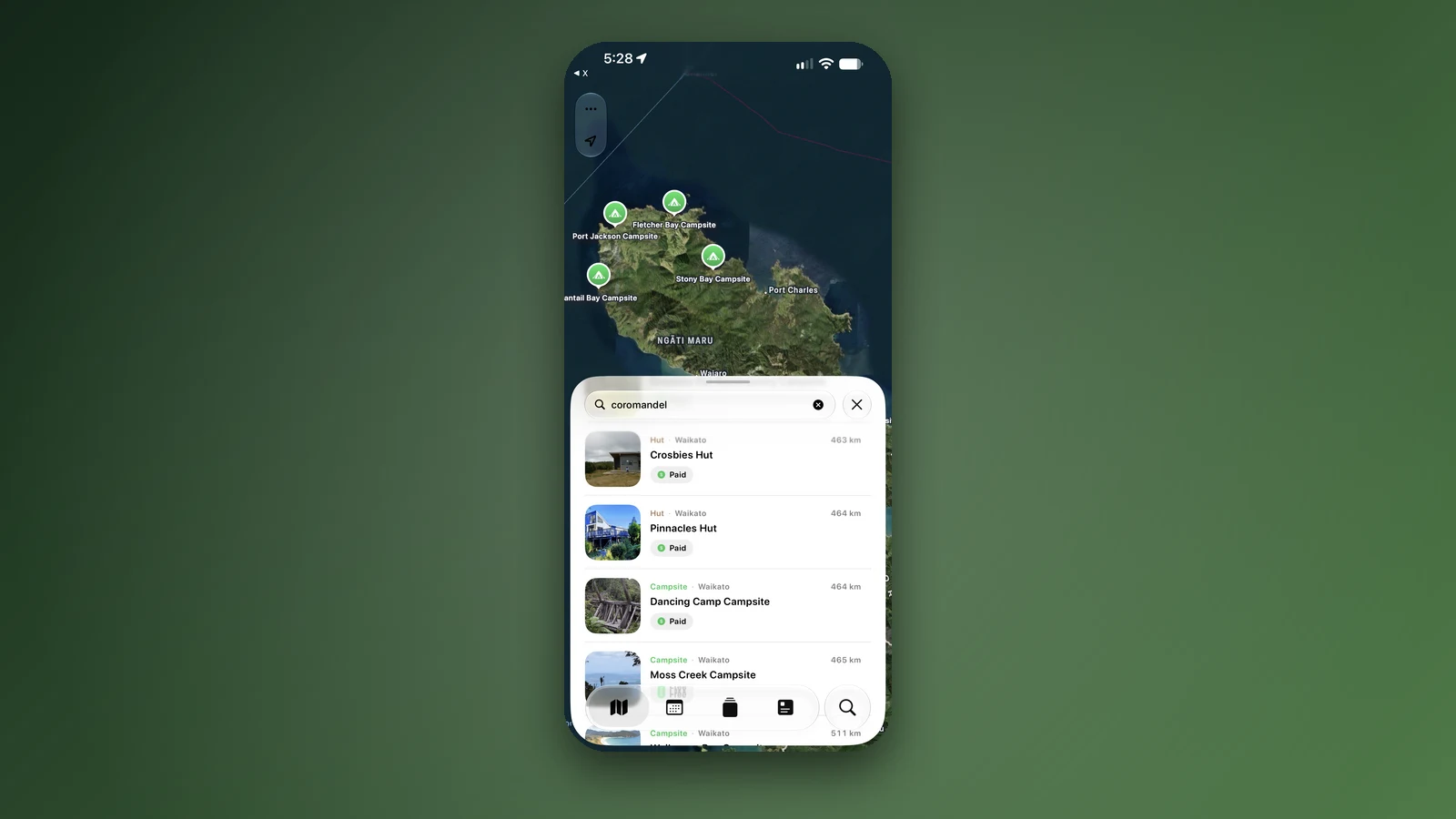
- Filter for facilities your van lacks
- Save the stops for the first week
- Check the DOC page for fees
Places along the way
Check before you go
Rules and conditions change. Recheck the official source and the page for your exact park or campground before departure.
- Consumer Protection: buying a car from a dealer
- Consumer Protection: buying a car privately
- Consumer Protection: before buying a used car
- PPSR: schedule of fees
- NZTA Vehicle Inspection Portal: changes to light vehicle inspections from 1 November 2026
- NZTA: warrant of fitness
- NZTA: vehicle ownership
- NZTA: licensing fees
- NZTA: road user charges rates and transaction fees
- PGDB: self-contained vehicles, private vehicle owners
- DOC: freedom camping
- Travellers Autobarn: Toyota Hiace campervans for sale
- Turners: used caravans and motorhomes
Common questions
Do I need a WoF to buy a campervan in New Zealand?+
The van needs a current WoF to be driven on the road. NZTA's rules change on 1 November 2026: vehicles registered on or after 1 November 2019 move to a WoF every 2 years, and vehicles 14 to 26 years old stay annual. The infringement fee for a WoF expired more than 2 months rises from $200 to $350.
How do I register a campervan in my name in NZ?+
Tell NZTA of the change of ownership, which is free online, using form MR13B. NZTA says a buyer without a New Zealand driver licence must go to an NZTA agent, so ask the agent what ID and address proof they need.
Can I freedom camp in a campervan I bought in New Zealand?+
Only on public land where self-contained vehicles are allowed, and only with a certified self-contained vehicle showing a green warrant. Blue stickers stopped counting on 7 June 2026. The vehicle needs a fixed toilet.
How do I check a used campervan for money owing in NZ?+
Search the PPSR by registration number, chassis number or VIN. A search costs $2.30 with GST, and Consumer Protection recommends it because a lender can take back a vehicle with money owing, even if the seller did not mention it.

Plan the drive
Save the stops. Plan the whole trip.
Free to download. BookIt holiday parks and tours are free to browse and book; DOC campsites, huts, dump stations, the in-app guides and trip planning need the Premium pass.
KiwiCamping is an iPhone app. There is no Android version.