Kauri dieback moves in contaminated soil and has no cure. Camping gear creates many contact points, so cleaning only hiking boots is not enough.
Arrive clean
Scrub every visible clump of soil from footwear, poles, tent pegs, mats, bike tyres and tools before entering kauri country. Clean at home or another suitable hard surface where wash water cannot reach the forest.
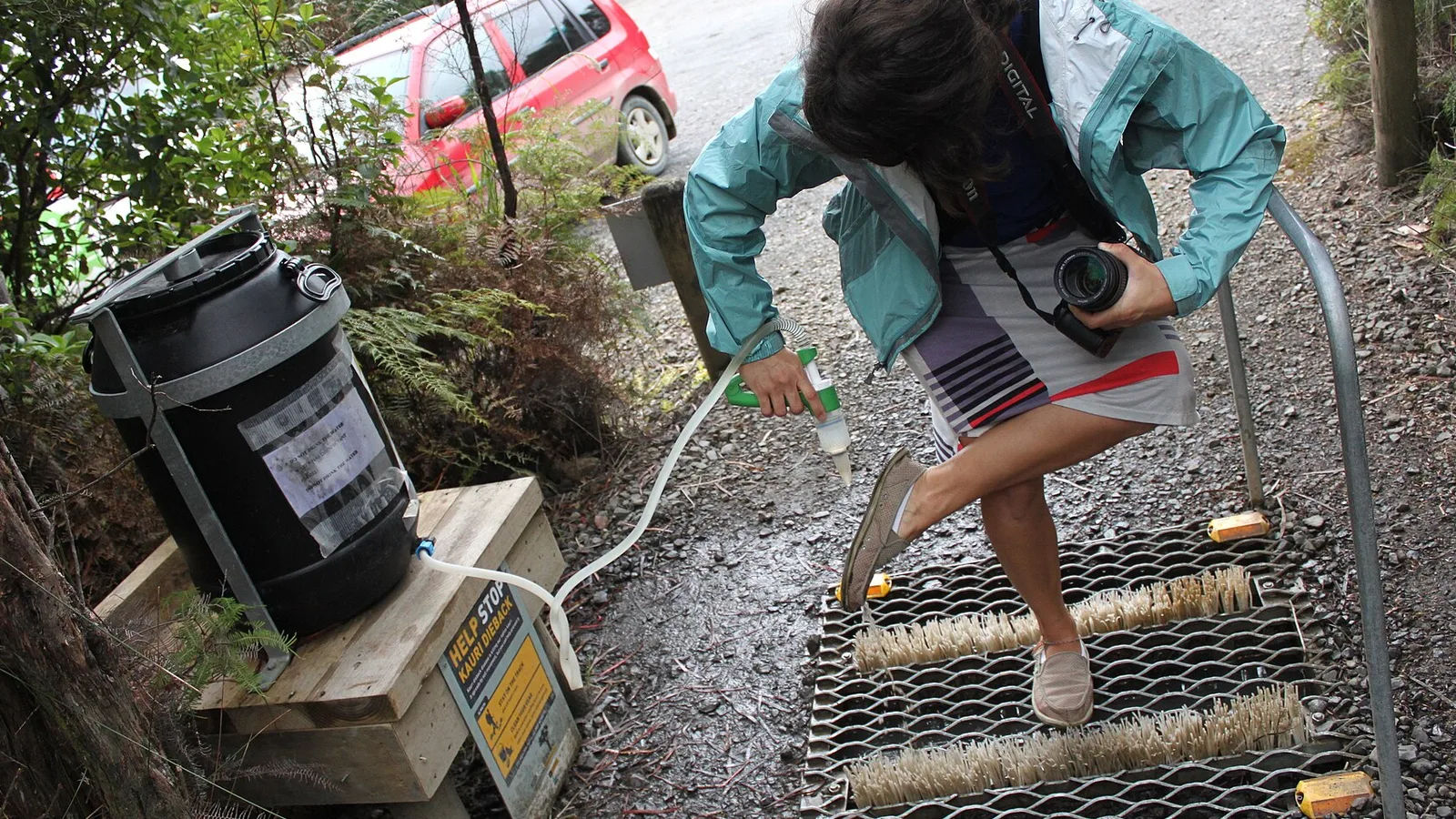
Use every hygiene station in the direction shown, even when equipment looks clean. Disinfectant works only after soil has been removed.
Stay on open tracks
Obey closures, barriers and boardwalk instructions. Stepping around mud widens the contaminated area and can move soil toward kauri roots.
Choose another walk when a track is closed. An old guide or GPS line does not authorise access through a protection zone.
Clean between regions
Repeat cleaning before leaving a forest area and before the next kauri catchment. Store dirty equipment separately until it can be treated properly.
Dogs can also move contaminated soil and may be prohibited for additional conservation reasons. Check both kauri and pet rules.
How the disease actually spreads
Kauri dieback is caused by a soil-borne pathogen that moves in a single gram of soil on a boot, a tent peg, a bike tyre or a dog's paws. There is no cure and infected trees die. The spread is almost entirely human-assisted, which is why the hygiene stations exist.
The critical part is mechanical: you must physically scrub the soil off before the disinfectant does anything. Spraying over caked mud achieves nothing at all, and this is the step most visitors skip.
- Scrub the soil off first, then spray
- One gram of soil can carry it
- Spraying over mud does nothing
Stay on the structures
In kauri forest the boardwalks and matting are not a convenience, they are the containment. Stepping off to pass someone, to take a photograph or to reach a better angle puts soil onto your boots from within the root zone, which extends well beyond the visible canopy.
Kauri roots are shallow and wide, and compaction damages them directly as well as spreading the pathogen. The structures exist because walking on the ground near a kauri harms it twice.
Some tracks are closed permanently
Large parts of the Waitākere Ranges and other northern forests have been closed under rāhui and formal closures, and some will not reopen. Old blog posts and guidebooks describing these walks circulate widely and are no longer accurate.
Check the current DOC and Auckland Council status before planning a walk to a specific tree or track. Entering a closed area is both an offence and a direct threat to the stand it is protecting.
- Old guides list closed tracks
- Check DOC and council status first
- Rāhui closures are not advisory
Clean gear before you arrive, not just between tracks
Arriving in Northland or the Coromandel with soil from another region on your boots is how the pathogen moves between forests. Clean and dry footwear, tent pegs, poles and groundsheets before you travel north, not only at the track entrance.
The same applies to vehicles on unsealed forestry roads and to dogs, which are prohibited in most kauri areas partly for this reason. Treat soil as the thing you are managing rather than mud as an inconvenience.
Why it matters beyond the trees
Kauri are foundation species: entire communities of plants, fungi and invertebrates depend on them and some exist nowhere else. Losing a stand is not losing trees, it is losing the system built around them over centuries.
They are also taonga, with individual trees named and carrying whakapapa and history. Tane Mahuta and Te Matua Ngahere are not tourist attractions in the ordinary sense, and the rahui placed over affected forests reflect that standing.
The hygiene measures ask very little of any individual visitor. Thirty seconds at a cleaning station and staying on a boardwalk is the entire contribution required, and it is currently the only thing slowing the spread.
What to do if you find a sick tree
Symptoms include yellowing foliage, canopy thinning, dead branches and a gum bleed at the base of the trunk. If you see them, note the location and report it rather than approaching for a closer look.
Do not take samples, touch the bleeding gum or move soil away from the tree. Reporting through DOC or the regional council is genuinely useful, because surveillance depends heavily on public reports.
- Gum bleed at the trunk base is the sign
- Report it, do not investigate
- Never move soil near a sick tree
Lugares por el camino
Comprueba antes de salir
Las normas y las condiciones cambian. Vuelve a consultar la fuente oficial y la página de tu parque o camping concreto antes de salir.
Preguntas frecuentes
What is kauri dieback and why does it matter to campers?+
It is a soil-borne disease that kills kauri and has no cure. It moves in a pinch of dirt on a boot or a tyre, which makes visitors the main way it spreads between forests.
How do you clean gear for kauri dieback?+
Scrub all soil off boots, poles, tyres and dog paws before and after every visit, then use the disinfectant stations at track entrances. Removing the soil is the part that works, and disinfectant on a muddy boot does nothing.
Llévalo a la carretera
Guarda las paradas. Planifica todo el viaje.
Monta una ruta ordenada con los lugares guardados, calcula la distancia y mantén fechas, notas y tareas asociadas.