A legal limit is not a promise that a road can be driven at that speed. Corners, rain, gravel, stock, cyclists and an unfamiliar campervan all reduce the safe pace.
Read each change
Speed limits vary by road and location, with temporary limits at works and lower zones around many communities or schools. Watch signs rather than relying on a remembered national default.
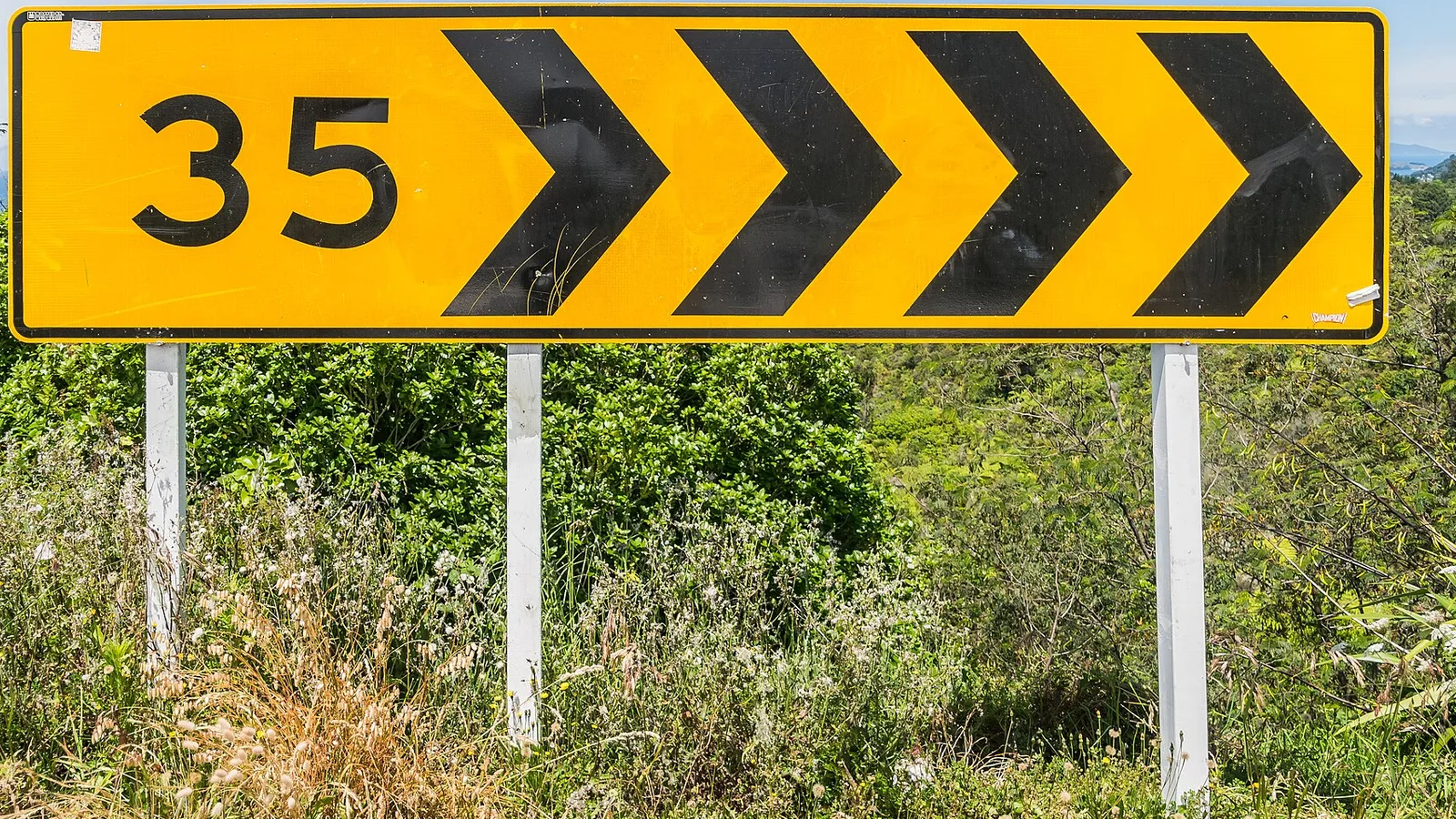
A yellow advisory speed before a corner is not the legal limit, but it communicates road geometry that deserves attention.
Slow before the hazard
Brake on the straight before entering a curve and keep enough margin to stop within the visible road. Gravel and wet leaves reduce grip well before a warning appears.
At night or in fog, reduce speed until the headlights reveal enough stopping distance. High beams cannot solve a winding road.
Do not create pressure
Let faster traffic pass at safe formed areas. Never speed up on a passing lane only to hold a queue again at the next bend.
If the planned arrival depends on driving at every posted maximum, the itinerary is already too tight.
The posted limit is a maximum, not a target
The open road limit is generally 100 km/h and urban areas are usually 50 km/h, with variable and reduced limits around schools, roadworks and some rural highways. The limit assumes ideal conditions, a car, and a driver familiar with the road.
Almost no New Zealand rural highway is comfortable at 100 km/h in a loaded campervan, in rain, or on an unfamiliar winding section. Driving at a speed that suits the conditions is both legal and expected, and driving too slowly on a straight is not the same thing as driving safely.
- 100 km/h open road, 50 urban
- Limits assume ideal conditions
- Towing is capped at 90 km/h
Enforcement is tighter than many visitors expect
The tolerance is small, speed cameras are widespread including mobile units, and fines are issued to the registered keeper, which means a rental company will pass them on with an administration fee. Points do not apply to overseas licences but fines certainly do.
Average speed enforcement and lower rural limits have both expanded in recent years. Assume any road may be monitored rather than looking for cameras.
Why the roads themselves demand less speed
New Zealand highways are largely two-lane, undivided, with tight radii, variable camber, one-lane bridges, unfenced stock and frequent unsealed side roads throwing gravel onto the surface. There is very little forgiving shoulder.
That combination is why crash rates involving visiting drivers are concentrated on rural roads. The safe pace is usually well below the limit, and the time lost across a day is a few minutes rather than the hour people imagine.
- Two-lane, undivided, little shoulder
- Gravel gets thrown onto sealed roads
- Driving slower costs minutes, not hours
Speed and the passing lane
Do not increase speed when a passing lane appears and someone is overtaking you. It is the most common source of conflict on New Zealand highways and it turns a safe overtake into a dangerous one.
Equally, if you are being followed closely, do not feel pressured to exceed a speed you are comfortable with. Use the next slow vehicle bay or safe pull-off and let them go; the pressure disappears and so does the risk.
Variable and reduced limits
Limits around schools drop at set times and are signed with flashing or variable displays. Roadworks carry temporary limits that apply whether or not anyone is visibly working, and they are enforced with the same small tolerance as permanent limits.
A number of rural highways have had limits reduced from 100 km/h following safety reviews, and the change is not always obvious if you are working from an older map or a previous visit. Read the signs rather than assuming the open road limit applies.
On unsealed roads the posted limit is frequently still 100 km/h, which is nowhere near a safe speed on gravel. Here the limit is genuinely a legal maximum rather than any indication of what the surface supports.
How speed cameras and fines work
Fixed and mobile cameras operate throughout the country and the enforcement tolerance is small. Fines are issued to the registered keeper, so a rental company receives them and passes them on with an administration fee.
Demerit points do not apply to an overseas licence but the fines do, and unpaid infringements can follow you. Pay them rather than assuming they disappear when you leave.
- Small enforcement tolerance
- Rentals add an admin fee
- Unpaid fines follow you
Orte entlang der Strecke
Vor der Abfahrt prüfen
Regeln und Bedingungen ändern sich. Prüfe vor der Abfahrt noch einmal die offizielle Quelle und die Seite deines konkreten Parks oder Campingplatzes.
Häufige Fragen
What is the open road speed limit in New Zealand?+
100 km/h unless signed otherwise, 50 km/h in urban areas, and 90 km/h if you are towing. Some highways are signed at 110 km/h and many rural roads are signed lower.
Why do New Zealand roads take longer than the distance suggests?+
Because the posted limit is rarely achievable. The roads are narrow, winding and often single lane in each direction, so a realistic average is well under the limit and a 300 km day is a full day.
Nimm es mit auf die Straße
Stopps speichern. Ganze Reise planen.
Bau aus gespeicherten Orten eine geordnete Route, berechne die Entfernung und behalte Termine, Notizen und To-dos daran.