The Abel Tasman Coast Track has 18 campsites and 4 huts, and DOC says all of them must be booked in advance all year round. From 1 October to 30 April you can stay at most two nights at one hut or campsite, and an adult campsite costs $21 for New Zealanders and $31 for international visitors. Bookings for 2026/27 opened on 14 May 2026, and DOC's page says there is strictly no freedom camping on the track. This page lists the campsites in walking order, with the tides, transport and rules that decide where you sleep.
The 18 campsites, south to north
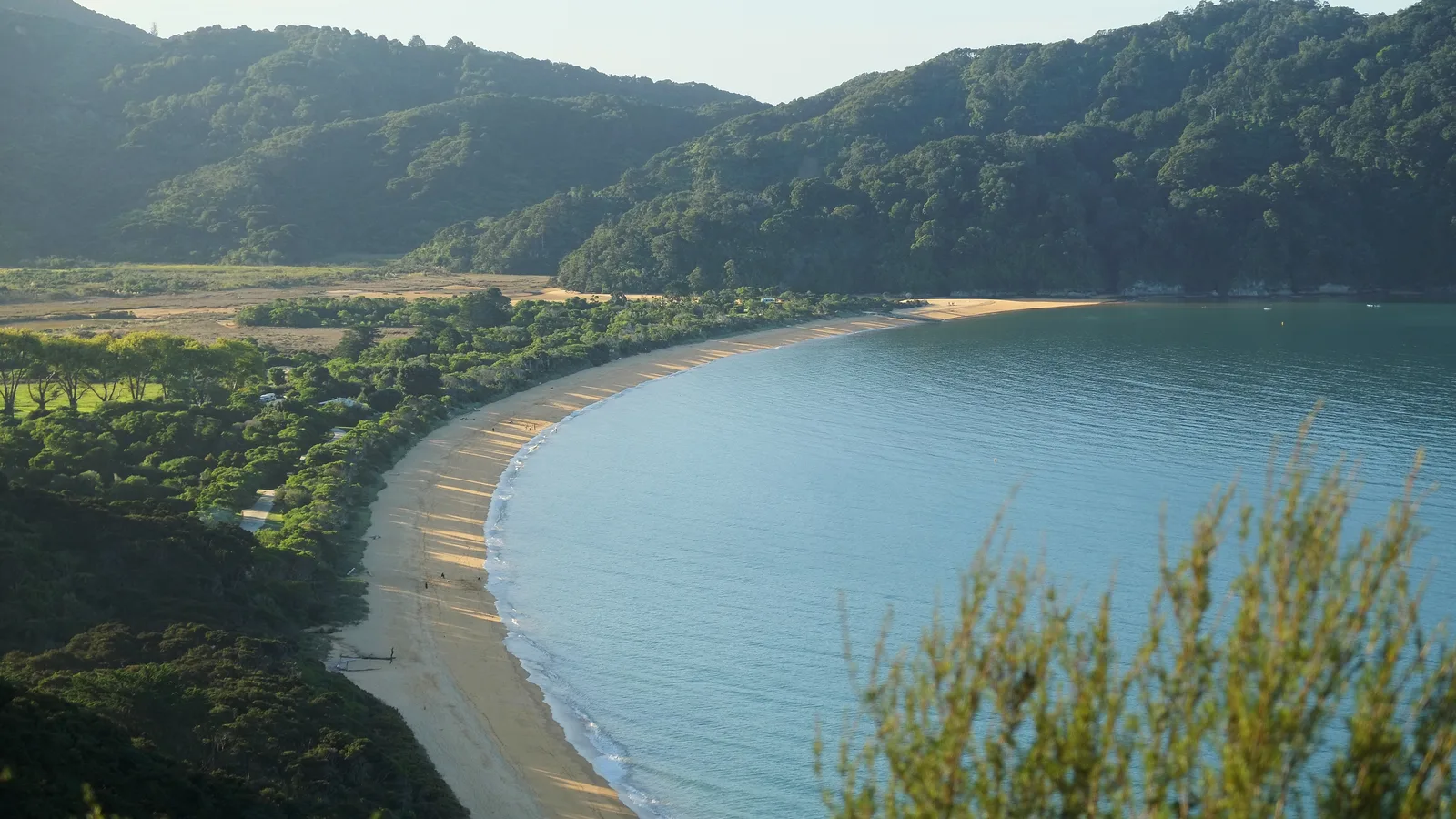
DOC lists the campsites in the order you meet them. Between Marahau and Anchorage there are eight: Tinline, Coquille Bay, Apple Tree Bay, Akersten Bay, Watering Cove, Observation Beach, Te Pukatea Bay and Anchorage. Torrent Bay Village and Bark Bay follow, then Mosquito Bay, Onetahuti Bay and Awaroa between Bark Bay and Awaroa, and Waiharakeke Bay, Tōtaranui Great Walk Campsite, Anapai Bay, Mutton Cove and Whariwharangi Bay on the way to the northern end.
Mosquito Bay is the exception: DOC says it can only be accessed by private boat, such as a kayak, so it is not a walking stop. The four huts are Anchorage, Bark Bay, Awaroa and Whariwharangi Bay, and DOC says campers may not use hut facilities. School groups may book only nine of the campsites, which DOC names as Tinline, Apple Tree, Anchorage, Bark Bay, Onetahuti, Awaroa, Tōtaranui, Mutton Cove and Whariwharangi, with a limit of 40 young people per site per night.
| Section | Campsites | Notes from DOC |
|---|---|---|
| Marahau to Anchorage | Tinline, Coquille Bay, Apple Tree Bay, Akersten Bay, Watering Cove, Observation Beach, Te Pukatea Bay, Anchorage | Eight campsites; Anchorage also has a hut |
| Anchorage to Bark Bay | Torrent Bay Village, Bark Bay | Torrent Bay estuary has an all-tide track; Bark Bay Hut |
| Bark Bay to Awaroa | Mosquito Bay, Onetahuti Bay, Awaroa | Mosquito Bay by private boat only; Awaroa Hut; Awaroa Inlet crossing |
| Awaroa to Tōtaranui | Waiharakeke Bay, Tōtaranui Great Walk Campsite | Tōtaranui can be booked for one night only, all year |
| Tōtaranui to Whariwharangi | Anapai Bay, Mutton Cove, Whariwharangi Bay | Whariwharangi Hut; no water taxis go beyond Tōtaranui |
- Mosquito Bay is reached by boat only
- Campers cannot use the huts
- Eight campsites sit between Marahau and Anchorage
Booking and how long you can stay
Huts and campsites must be booked in advance all year round, through DOC's booking system. DOC set the 2026/27 opening for this track at 9:30 am on Thursday 14 May 2026 for stays up to 30 June 2027, and it has not published the 2027/28 date. Without a valid booking you may be charged a penalty, or turned away if the hut or campsite is full, so turning up and hoping is not an option.
The stay limit is two nights at any hut or campsite from 1 October to 30 April and five nights from 1 May to 30 September, and the Tōtaranui Great Walk Campsite can be booked for one night all year. That one-night rule matters at the northern end, where many walkers want a second night. DOC's Tōtaranui Campground, the drive-in site reached by road, is a different booking and is covered in the Christmas and summer guide.
- Booking is needed all year
- Two nights in summer, five in winter
- Tōtaranui Great Walk Campsite is one night only
287 DOC campsites, 927 huts and 262 dump stations in one app
What it costs
DOC's fee for a campsite is per person, per night. The adult rate is $21 for New Zealanders and $31 for international visitors from 1 October to 30 April, and $21 for everyone from 1 May to 30 September. Huts are $55 for New Zealand adults and $84 for international adults in summer, dropping to $42 in May, June and September and $33 in July and August. DOC lists children aged 5 to 17 and infants aged 0 to 4 at reduced rates, with infants free, and day walks and park entry are free.
To claim the New Zealand rate you need proof of eligibility, and the Great Walks terms explain what DOC accepts. Water taxis are booked with the operators, not through DOC. DOC's page says they must be booked in advance, and that they run between Marahau or Kaiteriteri and Tōtaranui.
| Period | Hut, New Zealand adult | Hut, international adult | Campsite, New Zealand adult | Campsite, international adult |
|---|---|---|---|---|
| 1 October to 30 April | $55 | $84 | $21 | $31 |
| 1 May to 30 June | $42 | $42 | $21 | $21 |
| 1 July to 31 August | $33 | $33 | - | - |
| 1 to 30 September | $42 | $42 | $21 | $21 |
- Campsite: $21 NZ, $31 international in summer
- Hut: $55 NZ, $84 international in summer
- Water taxis are booked separately
Tides, crossings and getting there
The Awaroa Inlet is the one crossing DOC calls compulsory, and there is no alternative track. DOC says to cross within 1 hour 30 minutes before and 2 hours after low tide, only in daylight, and to allow about 25 minutes. The Torrent Bay estuary can be crossed 2 hours either side of low tide, or you can use the all-tide track around it, and the Bark Bay estuary has the same 2-hour window with an all-tide track that takes about 10 minutes. Goat Bay's beach access is cut at large tides, so you wait for the tide to drop.
The track can be started from Marahau in the south or Wainui or Tōtaranui in the north, and DOC gives road distances from Nelson of 67 km to Marahau, 128 km to Wainui and 160 km to Tōtaranui. The last 12 km to Tōtaranui are unsealed but suitable for campervans, and DOC says parking at the road ends is at your own risk. Check the tide timetable before you choose your nights, because it decides which way round the Awaroa day works.
- Awaroa: 1h30 before to 2h after low tide
- Torrent Bay and Bark Bay have all-tide tracks
- Parking at the road ends is at your own risk
Rules at the campsites
DOC says to camp only at the site you booked, or you may be penalised, and that kayakers may camp elsewhere only for safety reasons. The campsites are for tents and are not suitable for hammocks, and DOC does not allow hammocks, including tree-hugger hammocks, at them. Water at huts and campsites is untreated and DOC says to boil it before use, there is no food on sale on the track and no emergency food, and huts have no gas cooking or lighting.
A drone needs a permit and DOC says flying one without a permit is strictly prohibited. Sandflies and wasps are present, so carry repellent and any wasp-sting medication, and after a long or strong earthquake or a sudden change in sea level DOC says to go to higher ground at once. The page does not state a rule on campfires or dogs, so check the individual campsite page before you pack either.
- Tents only, no hammocks
- Boil the water
- Check campsite pages for fires and dogs
When the campsites are full
DOC does not publish which nights are booked out, but it says Abel Tasman Coast Track huts reached around 95 per cent occupancy last summer and that many campsites still had good availability on busy walks, so the campsites are the better bet. Try different start points, a different direction or midweek nights, and remember that the stay limit forces you to move on each night or two.
If the Great Walk campsites are full, the Nelson/Tasman DOC campsites are the next step. KiwiCamping's DOC data (11 August 2026) lists 37 DOC campsites in the region, 25 of them Great Walk campsites, 31 bookable online through DOC, and the Tōtaranui Campground the largest. The Nelson, Abel Tasman and Golden Bay road trip guide covers the roads, and the holiday parks guide covers the beds around Kaiteriteri and Motueka.
- Campsites often have space when huts are full
- Try midweek nights
- 37 DOC campsites in Nelson/Tasman
Using KiwiCamping on the Abel Tasman
KiwiCamping lists the Abel Tasman campsites and huts with their category, fee notes and facilities, so you can see every bay on the map and compare campsites before booking on DOC's site. It does not show tide times or water taxi timetables, which come from the operators. Place details, saved places and guides can be read offline; map tiles, routing, weather and photos cannot.
Save each booked campsite to a trip in walking order, with the date and booking reference in a note and the water taxi time beside it. Every leg shows its distance and every place a forecast. Free to download, with in-app purchases.

- Save each booked night in order
- Tide times come from the operators
- Core place details work offline
Places along the way
Check before you go
Rules and conditions change. Recheck the official source and the page for your exact park or campground before departure.
Common questions
How many campsites are there on the Abel Tasman Coast Track?+
DOC lists 18 campsites and 4 huts, and says all must be booked in advance all year round.
How many nights can I stay at an Abel Tasman campsite?+
At most two nights at any hut or campsite from 1 October to 30 April and five nights from 1 May to 30 September. The Tōtaranui Great Walk Campsite can be booked for one night all year.
When can I cross the Awaroa Inlet?+
DOC says to cross within 1 hour 30 minutes before and 2 hours after low tide, in daylight only, allowing about 25 minutes. DOC lists no alternative track.

On the map
Find tonight's camp on the map.
Free to download. BookIt holiday parks and tours are free to browse and book; DOC campsites, huts, dump stations, the in-app guides and trip planning need the Premium pass.
KiwiCamping is an iPhone app. There is no Android version.